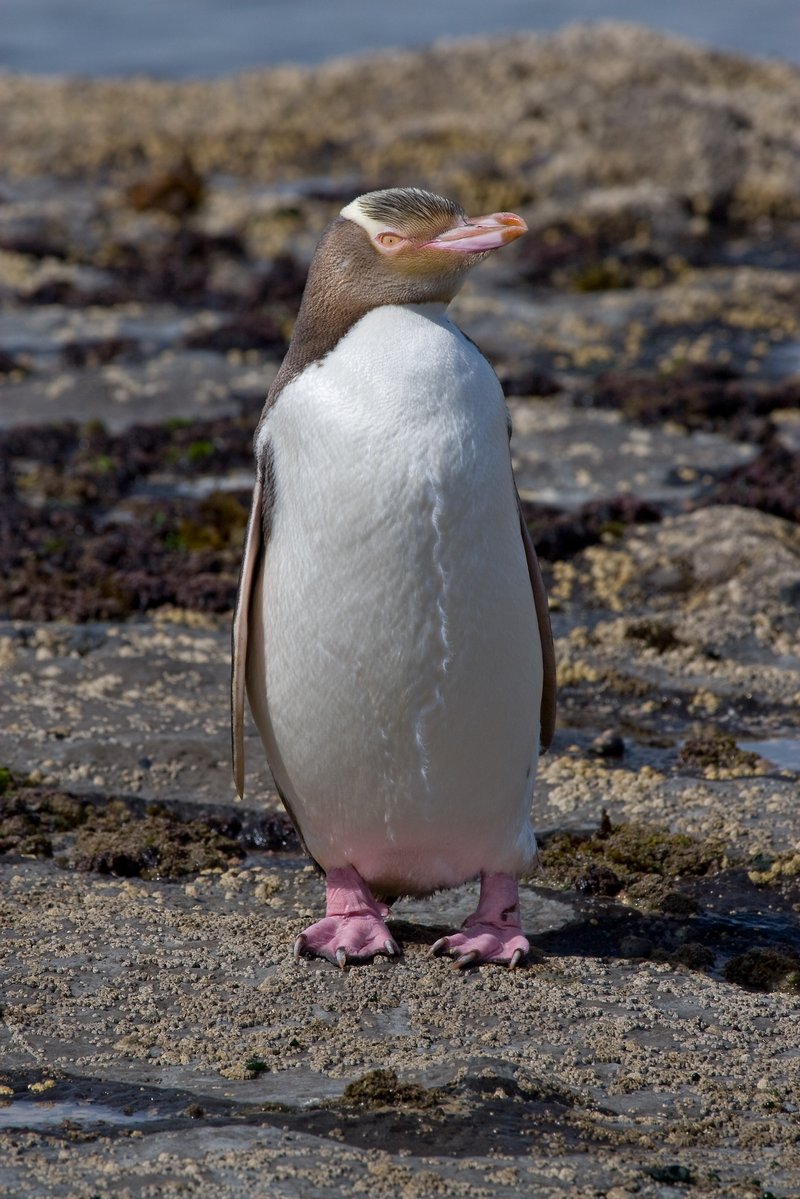
Photo: Brent Barrett via Wikimedia Commons (CC-BY-SA 2.0)
.jpg)
Yellow-eyed Penguin
Megadyptes antipodes
EndangeredOverview
The yellow-eyed penguin — hoiho in Māori, meaning "noise shouter" — is the most genetically distinct of all living penguin species. It belongs to its own genus, Megadyptes, having diverged from other penguins millions of years ago. With its pale yellow eyes, bright yellow band sweeping from eye to eye across the back of the head, and a wash of yellow across the face, it's one of the most recognizable penguins in the world. It's also one of the rarest.
Unlike most penguins, which breed in dense colonies, yellow-eyed penguins are solitary nesters. They prefer to nest in coastal forest and scrub, far enough apart that they can't see each other from their nest sites. This makes them especially vulnerable to habitat loss — they need forest, not just beach. They're also unusually sensitive to human disturbance; even the presence of tourists near nesting areas has been shown to reduce breeding success.
The species breeds along the southeast coast of New Zealand's South Island, on Stewart Island, and on the subantarctic Auckland and Campbell Islands. The mainland population has been in steep decline, with some breeding areas losing more than half their pairs in just a few years. When you're down to around 2,000 breeding pairs, every loss is felt.
IUCN Status
The IUCN Red List classifies the yellow-eyed penguin as Endangered (2024 assessment). This reflects ongoing population declines, particularly on the South Island mainland, where breeding pair numbers have dropped by over 50% in some areas during the past two decades. The total population of mature individuals is estimated at fewer than 4,000.
The species was previously listed as Vulnerable but was uplisted as evidence accumulated showing that declines were accelerating rather than stabilizing. The combination of habitat loss, predation, fisheries bycatch, and disease outbreaks has created a multi-front crisis that conservation efforts are struggling to address.
No MAPPPD Colony Data Available
Yellow-eyed penguins are not tracked by MAPPPD. Monitoring is conducted through direct surveys by the New Zealand Department of Conservation and the Yellow-eyed Penguin Trust. Visit IUCN Red List for assessment details.
Conservation
The yellow-eyed penguin is in trouble on multiple fronts simultaneously. Introduced predators — particularly stoats, ferrets, and feral cats — raid nests and kill adults on the South Island mainland. Habitat loss from coastal development and farming restricts breeding sites. Set nets (gillnets) used by commercial and recreational fishers drown penguins as bycatch, particularly in shallow coastal waters where the birds forage.
Disease has also hit hard. In 2018, a mysterious die-off killed significant numbers of adults at key mainland breeding sites, and toxic algae blooms have caused periodic mass mortality events. Barotrauma — injuries caused by rapid pressure changes when penguins surface quickly near fishing boats — has been documented as a significant cause of death.
The Yellow-eyed Penguin Trust, established in 1987, has been the leading force in conservation efforts: planting native vegetation to restore breeding habitat, trapping predators, and advocating for fishing restrictions near penguin foraging areas. The New Zealand Department of Conservation manages a recovery plan, and local community groups run nest-monitoring programs. But despite these efforts, mainland populations continue to decline, and some conservationists worry that the South Island population may be approaching a tipping point.
Why This Species Matters
Joel's note: The most genetically distinct penguin species. Pale yellow eyes, yellow head band, and only about 2,000 breeding pairs left. Every loss hurts. When a species is this rare, every individual matters — and they're still declining. The hoiho deserves better.
Sources
- IUCN Red List — Megadyptes antipodes (Endangered, 2024 assessment)
- BirdLife International — global authority on bird conservation status
- Wikipedia — Yellow-eyed penguin
- Wikimedia Commons — Photo source
- Yellow-eyed Penguin Trust — leading conservation organization
- NZ Department of Conservation — Hoiho recovery plan