Photo: Brent Barrett via Wikimedia Commons (CC-BY-SA 2.0)

Erect-crested Penguin
Eudyptes sclateri
VulnerableOverview
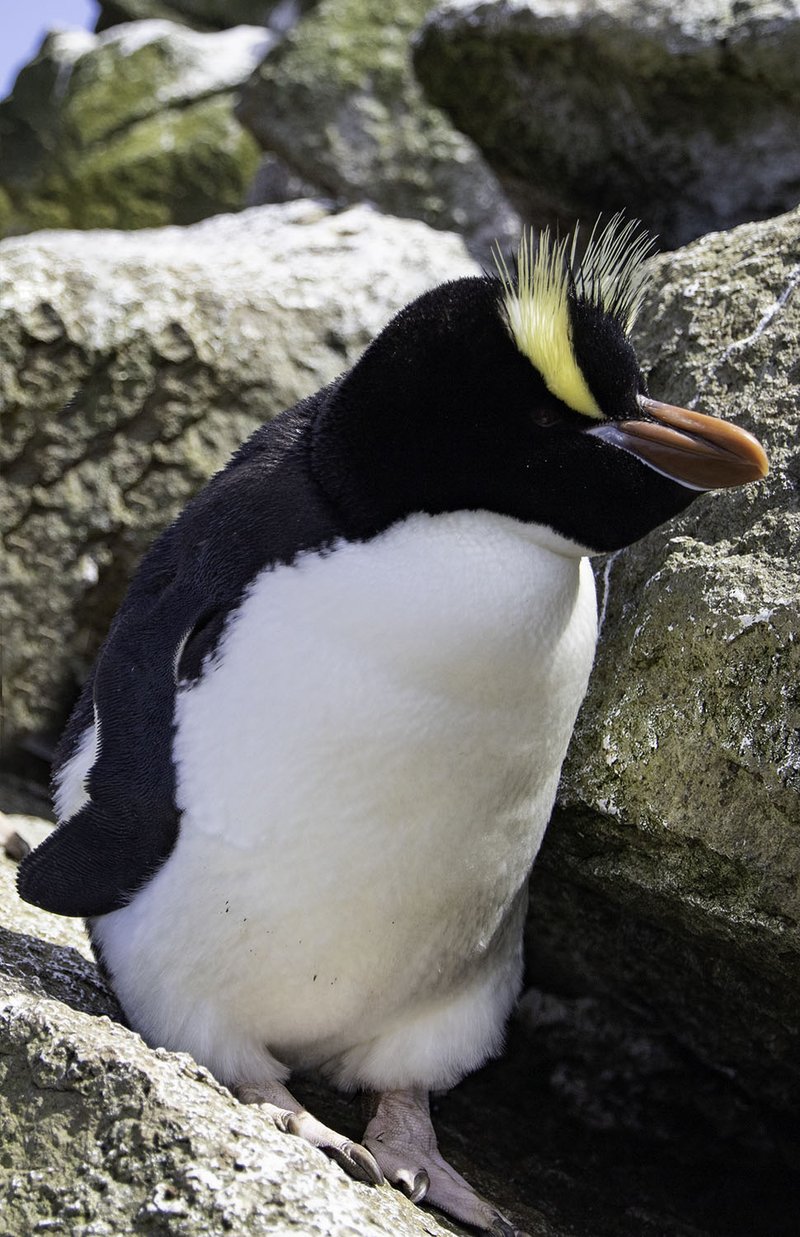
The erect-crested penguin is one of the least-studied penguin species on Earth, and that's saying something when your subject lives on islands so remote that researchers might visit once a decade. Breeding exclusively on the Bounty and Antipodes Islands — tiny, windswept outcrops southeast of New Zealand — this species is distinguished by its bold, stiff yellow crests that stand upright rather than drooping like those of other crested penguins.
What makes the erect-crested penguin particularly concerning is that its population is declining and nobody is entirely sure why. Estimates put the breeding population at around 30,000 to 40,000 pairs, but surveys are infrequent and methods vary. What is clear is that numbers have dropped since the 1970s, and the species is listed as Vulnerable precisely because the causes of decline remain poorly understood.
These penguins are remarkably adapted to their harsh environment. The Bounty and Antipodes Islands are exposed, rocky places with no trees and limited vegetation. Penguins nest in dense colonies on bare rock and among boulders, enduring relentless subantarctic winds. Their breeding biology includes an unusual trait: they deliberately reject the first egg they lay, prioritizing the second, larger egg — a strategy that may reflect adaptation to the unpredictable food availability in surrounding waters.
IUCN Status
The IUCN Red List classifies the erect-crested penguin as Vulnerable (2024 assessment). The listing is based on observed population declines and the species' restricted breeding range — confined to just two island groups. While the population is larger than some other Vulnerable penguin species, the unknown causes of decline and the difficulty of monitoring such remote colonies make it hard to assess whether conditions are improving or worsening.
The assessment acknowledges significant data gaps. The Bounty and Antipodes Islands are rarely visited, and comprehensive surveys are logistically challenging and expensive. Population trend data is therefore limited, and what exists suggests a decline of at least 30% over three generations.
No MAPPPD Colony Data Available
Erect-crested penguins are not tracked by MAPPPD. Population monitoring is limited by the extreme remoteness of the Bounty and Antipodes Islands. Visit IUCN Red List for assessment details.
Conservation
The erect-crested penguin's conservation story is defined by what we don't know. Unlike species where threats are well documented — introduced predators, fisheries bycatch, habitat loss — the erect-crested penguin breeds on predator-free islands with minimal human disturbance. Yet it's declining. The leading hypothesis is that changes in ocean productivity around the subantarctic zone are reducing prey availability, but the evidence remains circumstantial.
The Bounty Islands are designated as a Nature Reserve and the Antipodes Islands as a National Nature Reserve, both managed by New Zealand's Department of Conservation. These islands have no introduced mammals, which eliminates the predation threat that plagues many New Zealand penguin species. But marine threats — warming seas, shifting prey distribution, and potentially unrecorded fisheries interactions — are much harder to address.
The species' remote breeding sites, while protecting it from direct human impacts, also make it difficult to study. Researchers typically visit only once every few years, meaning population data is sparse and trend analysis uncertain. Improved monitoring — potentially through remote sensing and automated camera systems — is a conservation priority, as is understanding the oceanographic changes driving the species' decline.
Sources
- IUCN Red List — Eudyptes sclateri (Vulnerable, 2024 assessment)
- BirdLife International — global authority on bird conservation status
- Wikipedia — Erect-crested penguin
- Wikimedia Commons — Photo source
- NZ Department of Conservation — Antipodes and Bounty Islands management