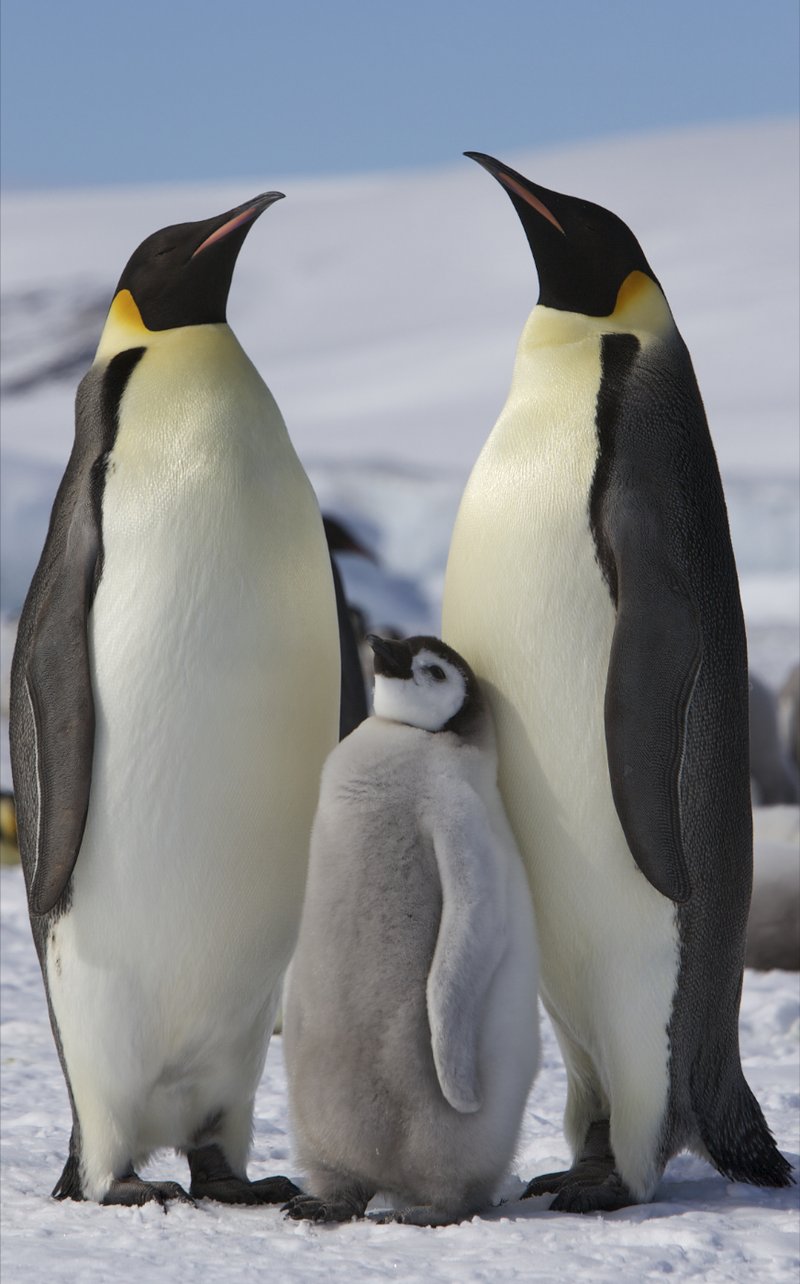
Photo: Ian Duffy via Wikimedia Commons (CC-BY-SA 2.0)

Emperor Penguin ⭐ Favorite
Aptenodytes forsteri
EndangeredOverview
The emperor penguin is the tallest and heaviest of all living penguin species, found exclusively in Antarctica. Standing up to 130 cm tall and weighing between 22 and 45 kg, these remarkable birds are supremely adapted to the harshest environment on Earth. Their striking plumage — black head and back sharply contrasting with a white belly and pale-yellow breast patches — provides both camouflage and a recognizable silhouette against the ice.
Emperor penguins are the only penguin species that breeds during the Antarctic winter. Males endure temperatures as low as −60°C and winds of 200 km/h while balancing a single egg on their feet for over two months, huddling together in massive formations for warmth. The females return to the sea to feed, sometimes traveling 50–120 km over the ice to reach open water.
Their survival depends entirely on sea ice — for breeding, for resting between foraging dives, and as a platform from which chicks can fledge. This makes them uniquely vulnerable to climate change. As Antarctic sea ice diminishes, emperor penguins face an existential threat that no amount of evolutionary adaptation can outpace.
IUCN Status
In 2026, the IUCN Red List classified the emperor penguin as Endangered, upgrading it from Near Threatened. The change reflects accelerating sea ice loss across Antarctica and increasingly frequent breeding failures observed at monitored colonies. Models project that under current warming trajectories, 99% of emperor penguin colonies could be lost by 2100.
The uplisting followed years of evidence showing that several major colonies — including Halley Bay, once the second-largest emperor penguin colony in the world — experienced near-total breeding failures in consecutive years due to early sea ice breakup. These events, once rare, are becoming alarmingly common.
Colony Data Available
Colony data sourced from MAPPPD (Mapping Application for Penguin Populations and Projected Dynamics). Visit penguinmap.com for full interactive data.
Conservation
The emperor penguin's dependence on stable sea ice makes it one of the most climate-vulnerable species on Earth. Unlike other penguins that breed on land, emperors need sea ice that persists through the Antarctic winter and doesn't break up before chicks have fledged. Satellite imagery has documented repeated breeding failures as ice fractures prematurely, sending thousands of chicks into the ocean before they've grown their waterproof feathers.
In 2022, the US Fish and Wildlife Service listed the emperor penguin as threatened under the Endangered Species Act, citing projections that show significant population declines across most colonies by mid-century. Under a high-emissions scenario, the species faces functional extinction in the wild by 2100 — meaning 99% of colonies would be lost.
Conservation efforts focus on protecting marine foraging grounds, reducing fishing pressure near colonies, and — most critically — reducing greenhouse gas emissions to slow Antarctic sea ice loss. The Commission for the Conservation of Antarctic Marine Living Resources (CCAMLR) has established marine protected areas, but enforcement remains inconsistent and coverage incomplete.
Why This Species Matters
Joel's note: This is my favorite penguin. I built this entire project because emperor penguins matter to me. They breed on sea ice that's disappearing — and they have nowhere else to go. The fact that an animal perfectly adapted to the harshest conditions on Earth can be undone by human-caused warming in a single generation is something I think about a lot. If you're reading this, I hope it makes you think about it too.
Sources
- IUCN Red List — Aptenodytes forsteri (Endangered, 2026 assessment)
- BirdLife International — global authority on bird conservation status
- Wikipedia — Emperor penguin
- Wikimedia Commons — Photo source
- MAPPPD — Penguin colony tracking data