Photo: Brocken Inaglory via Wikimedia Commons (CC-BY-SA 3.0)
%E2%80%93King_penguin_(Aptenodytes_patagonicus)_04.jpg)
King Penguin
Aptenodytes patagonicus
Least ConcernOverview
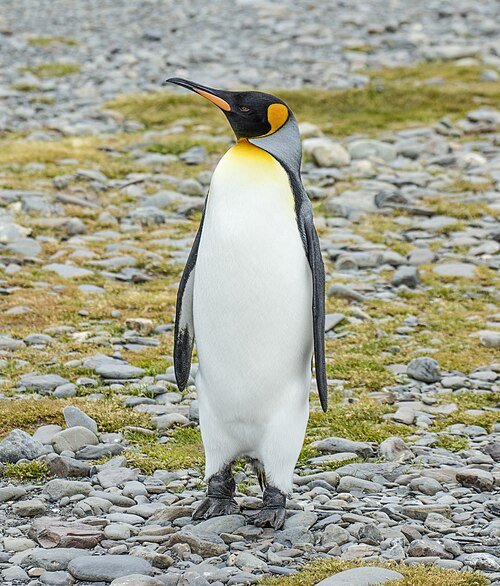
The king penguin is the second-largest penguin species — smaller only than the emperor — and one of the most visually striking. With vivid orange-gold patches on the sides of its head and upper chest, a long dark bill, and an upright posture that seems almost regal, it's easy to see how it earned its name. King penguins breed on subantarctic islands from South Georgia to Macquarie Island, forming vast, densely packed colonies that can contain hundreds of thousands of individuals.
What makes the king penguin truly remarkable is its breeding cycle. At 14–16 months, it's the longest of any penguin — so long that a breeding pair can successfully raise only two chicks every three years. This marathon reproductive effort is a stark contrast to smaller penguins that can fledge a chick in a single summer season. Both parents take turns making extended foraging trips, sometimes diving to depths exceeding 300 meters in search of lanternfish and squid.
The species is currently stable or increasing across most of its range, and some colonies — particularly on South Georgia and the Crozet Islands — have grown substantially in recent decades. King penguins are thought to have recovered well from 19th and early 20th-century exploitation for oil and feathers, when they were harvested in enormous numbers at some breeding sites.
IUCN Status
The king penguin is classified as Least Concern on the IUCN Red List (2025 assessment). With roughly 2.2 million breeding pairs and a population that's generally stable or increasing, the species is not currently at risk of extinction. Several major colonies are growing, and the overall trend is positive.
However, the Least Concern classification comes with important caveats. The species' extremely long breeding cycle makes it inherently vulnerable to disruption — any environmental change that extends the cycle further or reduces foraging success can quickly cascade into population-level impacts. Climate models project that some subantarctic foraging grounds could become less productive as ocean temperatures shift, potentially stranding king penguins between breeding islands and productive feeding zones.
Colony Data Available
Colony data sourced from MAPPPD (Mapping Application for Penguin Populations and Projected Dynamics). Visit penguinmap.com for full interactive data.
Conservation
While currently Least Concern, the king penguin faces a long-term threat that could fundamentally reshape its future: the shifting polar front. King penguins forage at the Antarctic Polar Front — a zone where cold Antarctic waters meet warmer subantarctic currents, creating the upwelling that supports their main prey, lanternfish. Climate models suggest this front is moving southward, and if it shifts beyond the foraging range of breeding adults from their colony islands, the result could be catastrophic.
A 2018 study projected that under current warming trajectories, 70% of king penguins — roughly 1.1 million breeding pairs — could face the loss of their primary foraging grounds by 2100. The Crozet and Prince Edward Islands, home to the largest colonies, are particularly vulnerable because the polar front is projected to move beyond their foraging radius.
Their extraordinarily long breeding cycle amplifies any disruption. A king penguin pair that fails to fledge a chick loses an entire year of reproductive effort. Unlike Adélies or chinstraps that can try again the next season, king penguins simply run out of time. Multiple consecutive breeding failures — from food shortages, storms, or foraging ground shifts — could trigger rapid population declines despite the species' currently healthy numbers.
Sources
- IUCN Red List — Aptenodytes patagonicus (Least Concern, 2025 assessment)
- BirdLife International — global authority on bird conservation status
- Wikipedia — King penguin
- Wikimedia Commons — Photo source
- MAPPPD — Penguin colony tracking data