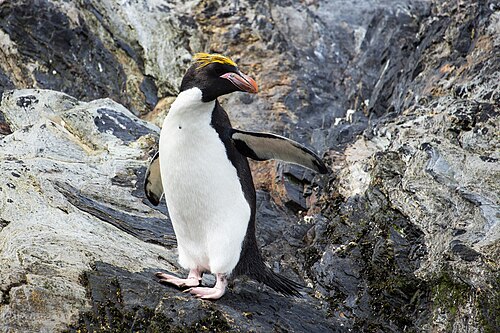
Photo: Christine Zenino via Wikimedia Commons (CC-BY 2.0)
.jpg)
Macaroni Penguin
Eudyptes chrysolophus
VulnerableOverview
The macaroni penguin is one of the most abundant penguin species on Earth — and one of the most alarming in decline. With its striking yellow-orange crest feathers fanning backward from the forehead like some extravagant 18th-century hat (the "macaroni" in the name refers to the Macaroni fashion subculture, not pasta), this crested penguin breeds in massive colonies on subantarctic islands and the Antarctic Peninsula.
Macaroni penguins form some of the densest breeding colonies of any penguin species, with up to 100,000 individuals packed onto a single island headland. They're intensely social and vocal, with elaborate courtship displays that involve head-swinging, calling, and mutual preening. Both parents share incubation and chick-rearing duties in short, alternating shifts.
Despite their apparent abundance — roughly 6.3 million breeding pairs — the species has experienced catastrophic declines since the 1970s. Some colonies have lost more than half their populations in a single generation. The disconnect between "most numerous" and "fastest declining" makes the macaroni penguin a stark illustration of how population size can mask the speed of collapse.
IUCN Status
The macaroni penguin is classified as Vulnerable on the IUCN Red List (2025 assessment), reflecting rapid population declines that have reduced the global population by approximately 50% over three generations. The species was previously listed as Vulnerable in 2021 and has remained at this level as monitoring continues to show concerning trends at key sites.
The steepest declines have been documented at South Georgia, once home to the world's largest macaroni colony. Surveys there show decreases of over 50% since the 1980s, with similar patterns at Marion Island, Îles Crozet, and other subantarctic breeding sites. Only a few populations, such as those in the Falkland Islands, appear stable.
Colony Data Available
Colony data sourced from MAPPPD (Mapping Application for Penguin Populations and Projected Dynamics). Visit penguinmap.com for full interactive data.
Conservation
The macaroni penguin's 50% population decline since the 1970s is one of the most dramatic among any penguin species, and the causes are a combination of climate change, fishing competition, and possibly disease. Declining krill availability around key breeding sites is the primary suspect — macaroni penguins are heavy krill consumers, eating more marine life per year than any other seabird species, and krill populations have shifted dramatically with warming waters.
Competition with commercial krill fisheries adds another layer of pressure. As demand for krill-based products (aquaculture feed, omega-3 supplements) grows, fishing vessels increasingly operate near penguin foraging grounds, potentially depleting food sources during critical breeding periods.
The species' long migratory patterns — macaroni penguins travel over 10,000 km across the Southern Ocean between breeding seasons — make them vulnerable to changing ocean conditions across vast areas. A penguin that breeds on South Georgia but winters in the Indian Ocean is exposed to environmental pressures across an enormous range, making targeted conservation difficult.
Sources
- IUCN Red List — Eudyptes chrysolophus (Vulnerable, 2025 assessment)
- BirdLife International — global authority on bird conservation status
- Wikipedia — Macaroni penguin
- Wikimedia Commons — Photo source
- MAPPPD — Penguin colony tracking data