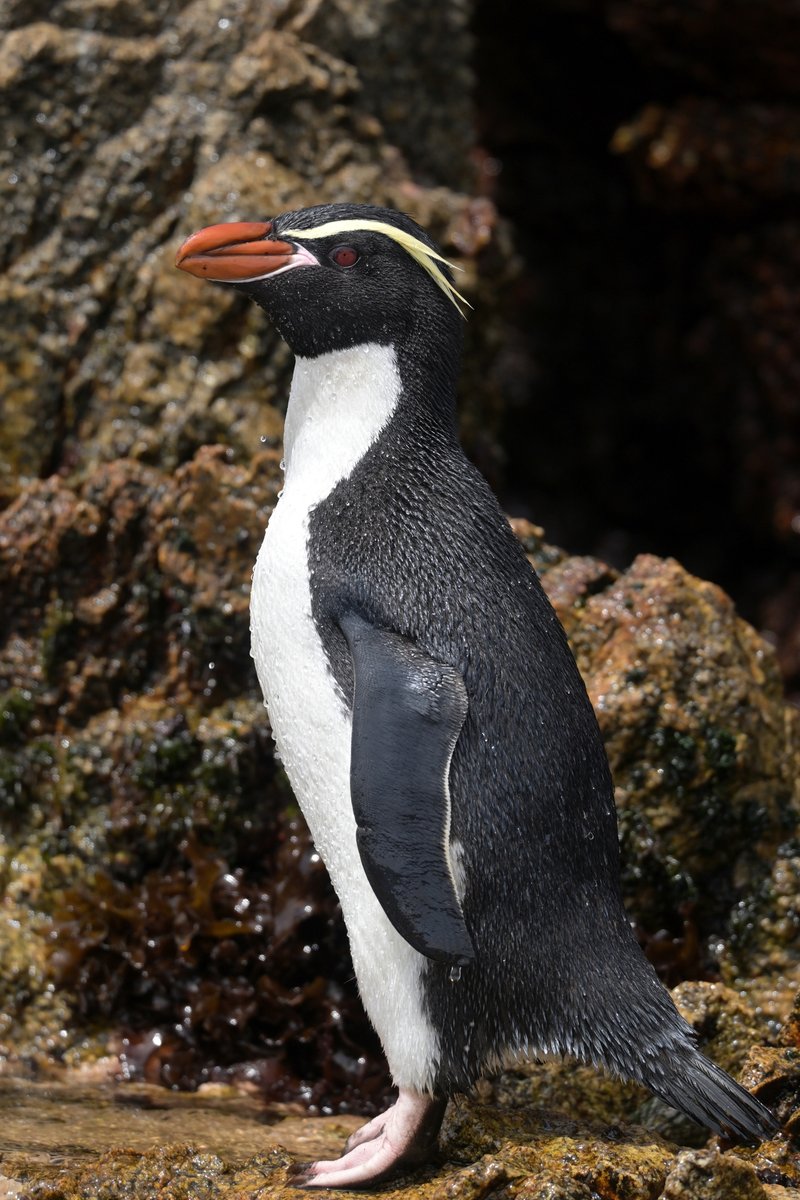
Photo: JJ Harrison via Wikimedia Commons (CC-BY-SA 4.0)

Snares Penguin
Eudyptes robustus
VulnerableOverview
The Snares penguin — known as pokotiwha in Māori — breeds on one of the smallest land areas of any penguin species. The Snares Islands, a cluster of rocky islets roughly 200 km south of New Zealand's South Island, cover barely 3.4 km² combined. Every single breeding pair of Snares penguins nests there. Nowhere else on Earth.
With roughly 25,000 breeding pairs, the population is not tiny in absolute terms, but its concentration on such a small area creates an extreme vulnerability. A single environmental catastrophe — an oil spill, a disease outbreak, or the accidental introduction of mammalian predators — could affect the entire species at once. The Snares Islands are currently free of introduced mammals, and keeping them that way is a conservation priority of the highest order.
Snares penguins are medium-sized crested penguins with a bold yellow crest that starts at the base of the bill and sweeps backward above bright red eyes. They're closely related to the Fiordland crested penguin and the erect-crested penguin, and the three species share similar appearance and behavior. What distinguishes the Snares penguin is its uniquely restricted range — it's a textbook example of island endemism, where an entire species' existence depends on a patch of land you could walk across in under an hour.
IUCN Status
The IUCN Red List classifies the Snares penguin as Vulnerable (2024 assessment). While the population appears relatively stable at present, the species qualifies as Vulnerable because of its extremely restricted breeding range — limited to a single small island group — which makes it highly susceptible to stochastic events and localized threats.
The restricted range is the primary concern: with all breeding concentrated on 3.4 km² of land, even a moderate threat could rapidly escalate. The IUCN assessment notes that any change in conditions — whether from climate-driven shifts in prey availability or a single catastrophic event — could have species-level consequences.
No MAPPPD Colony Data Available
Snares penguins are not tracked by MAPPPD. Population monitoring is conducted through direct surveys of the Snares Islands by New Zealand researchers. Visit IUCN Red List for assessment details.
Conservation
The Snares Islands are among the most protected pieces of land in New Zealand. As a National Nature Reserve, access is strictly limited to permitted researchers, and the islands remain free of introduced mammals — a rare distinction among New Zealand's subantarctic islands. This protection is the single most important factor keeping the Snares penguin from sliding toward endangerment.
Climate change poses a longer-term threat. The subtropical front — an ocean boundary where warm and cold waters meet, creating productive foraging zones — is shifting southward. If this shift continues, Snares penguins may find their foraging grounds moving further from breeding colonies, increasing the energy costs of raising chicks and reducing breeding success over time.
Fisheries interactions, particularly squid fishing operations near the islands, represent another concern. While bycatch rates for Snares penguins are not well documented, competition with commercial fisheries for squid and small fish could intensify as ocean conditions change. Continued biosecurity vigilance — preventing any mammalian predators from reaching the islands — remains the most critical conservation action for this species.
Sources
- IUCN Red List — Eudyptes robustus (Vulnerable, 2024 assessment)
- BirdLife International — global authority on bird conservation status
- Wikipedia — Snares penguin
- Wikimedia Commons — Photo source
- NZ Department of Conservation — Snares Islands management