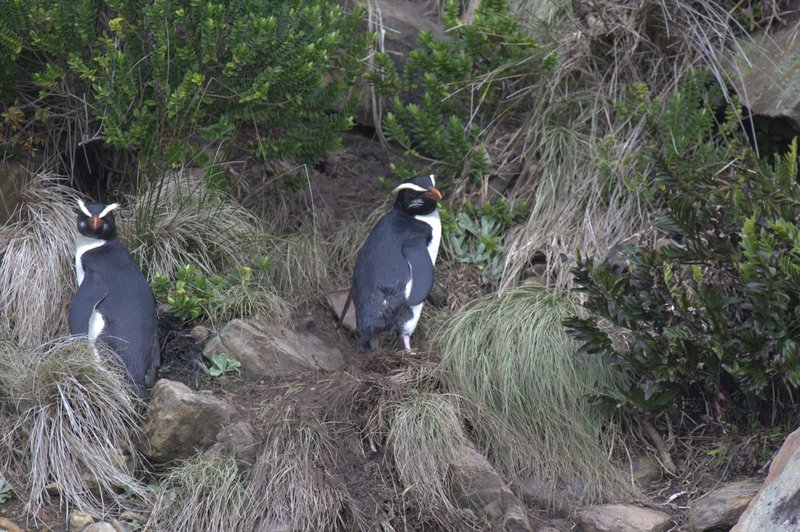
Photo: Kathy White via Wikimedia Commons (CC-BY-SA 4.0)

Fiordland Crested Penguin
Eudyptes pachyrhynchus
VulnerableOverview
The Fiordland crested penguin — also known as tawaki in Māori — is one of the rarest penguins on Earth, with only 2,500 to 3,000 breeding pairs remaining. But what makes this species truly remarkable isn't just its rarity. It's where it lives: in the rainforests of New Zealand's Fiordland and on Stewart Island. A penguin that nests in the forest. Think about that.
These penguins breed in dense, mossy vegetation beneath the canopy of temperate rainforest, their nests tucked among tree roots and fallen logs just meters from the surf. They're shy and elusive, making them one of the hardest penguin species to study. Researchers often rely on trail cameras and footprint surveys because the birds are so difficult to observe directly. They return to their breeding sites under the cover of darkness to avoid predators.
The Fiordland crested penguin's breeding range is restricted to the rugged southwestern coast of New Zealand's South Island and nearby Stewart Island. After breeding, they disperse into the waters of the Tasman Sea and Southern Ocean, where they forage over vast distances. Their dual life — forest nester, ocean forager — makes them dependent on two entirely different ecosystems, both of which face mounting pressures.
IUCN Status
The IUCN Red List classifies the Fiordland crested penguin as Vulnerable (2024 assessment). This designation reflects a small and declining population, with fewer than 3,000 breeding pairs restricted to a limited range. The species meets Vulnerable criteria under population size and trend thresholds.
Population monitoring is challenging due to the bird's secretive nesting habits, but studies have documented ongoing declines at surveyed sites. The small population size means that even moderate levels of additional mortality could push the species toward Endangered status in coming decades.
No MAPPPD Colony Data Available
Fiordland crested penguins are not tracked by MAPPPD. Monitoring relies on ground surveys in New Zealand's Fiordland. Visit IUCN Red List for assessment details.
Conservation
Introduced predators are the single greatest threat to Fiordland crested penguins. New Zealand's native birds evolved in the absence of mammalian predators, and the arrival of stoats, ferrets, rats, and feral cats has been devastating. Stoats are particularly efficient hunters — they raid nests for eggs and kill chicks, and they can access even the most hidden nesting sites in the forest undergrowth.
Habitat degradation compounds the problem. While much of their breeding habitat lies within Fiordland National Park, runoff from farmland, sedimentation in coastal waters, and human disturbance at popular tourist sites like Milford Sound all take a toll. Climate change adds uncertainty: warming seas may shift prey distribution, forcing adults to swim further from colonies during the critical breeding season.
New Zealand's Department of Conservation runs predator control programs across parts of the breeding range, and local conservation groups like the West Coast Penguin Trust conduct regular surveys and advocacy. But the species' remote, scattered nesting sites make comprehensive protection difficult. Every breeding pair matters when your total population is this small.
Why This Species Matters
Joel's note: This penguin nests in rainforests. A penguin that lives in the forest. Think about that. Evolution is wild — these birds traded open beaches for mossy forest floors, and they've been doing it for millions of years. With only a few thousand pairs left, every nest site matters.
Sources
- IUCN Red List — Eudyptes pachyrhynchus (Vulnerable, 2024 assessment)
- BirdLife International — global authority on bird conservation status
- Wikipedia — Fiordland crested penguin
- Wikimedia Commons — Photo source
- NZ Department of Conservation — Tawaki/Fiordland crested penguin