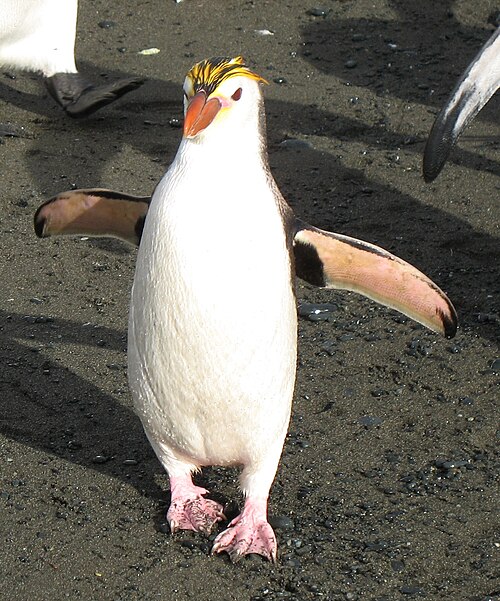
Photo: Liam Quinn via Wikimedia Commons (CC-BY-SA 2.0)

Royal Penguin
Eudyptes schlegeli
Near ThreatenedOverview
The royal penguin is a crested penguin found almost exclusively on Macquarie Island, a remote subantarctic island halfway between New Zealand and Antarctica. With its pale yellow crest and distinctive white chin — setting it apart from the similar-looking macaroni penguin, which has a black chin — the royal penguin is one of the most geographically restricted penguin species in the world.
During the 19th century, royal penguins were slaughtered in staggering numbers for their oil. Between 1810 and 1920, an estimated 150,000 penguins were boiled down for their fat at Macquarie Island's "penguin oil" operations. The species was pushed to the brink of extinction. Remarkably, they recovered after the industry shut down, and today roughly 850,000 breeding pairs crowd the island's beaches and slopes each breeding season.
Despite this recovery, the royal penguin's extreme geographic concentration makes it inherently vulnerable. Virtually the entire species breeds on a single island. Any catastrophe — a disease outbreak, an oil spill, or a major shift in ocean conditions around Macquarie — could affect the whole population simultaneously. It's a species that went from the edge of extinction to apparent security, but whose future remains conditional.
IUCN Status
The IUCN Red List classifies the royal penguin as Near Threatened (2024 assessment). While the current population is substantial at around 1.7 million individuals, the species qualifies as Near Threatened because of its extremely restricted breeding range — essentially a single island — and ongoing concerns about population trends.
The Near Threatened status reflects a "watch list" designation: the species isn't in immediate danger of extinction, but it's close enough to the thresholds for Vulnerable that any worsening of conditions could push it over the line. Climate change projections for the Southern Ocean, particularly shifts in krill distribution, are a key concern.
No MAPPPD Colony Data Available
Royal penguins are not tracked by MAPPPD. Monitoring relies on direct surveys at Macquarie Island. Visit IUCN Red List for the latest assessment.
Conservation
The royal penguin's story is a rare conservation success that comes with a major asterisk. After being nearly eradicated by the penguin oil industry, the species rebounded dramatically once the killing stopped — a testament to penguins' capacity for population recovery when the primary threat is removed. Macquarie Island was declared a wildlife sanctuary in 1933 and became a UNESCO World Heritage Site in 1997.
But the threat landscape has shifted from 19th-century oil boilers to 21st-century climate change. Warming ocean temperatures around Macquarie Island are changing the distribution of krill and other prey species. Royal penguins feed primarily in the polar front zone south of the island, and any southward shift in this productive zone could increase foraging distances and reduce breeding success.
The island itself has been the focus of a massive conservation effort — a decade-long, multi-million dollar project to eradicate invasive rabbits, rats, and mice that was declared successful in 2014. This represents one of the largest and most successful island restoration projects ever undertaken, and it has directly benefited royal penguins by restoring vegetation cover around breeding colonies.
Sources
- IUCN Red List — Eudyptes schlegeli (Near Threatened, 2024 assessment)
- BirdLife International — global authority on bird conservation status
- Wikipedia — Royal penguin
- Wikimedia Commons — Photo source