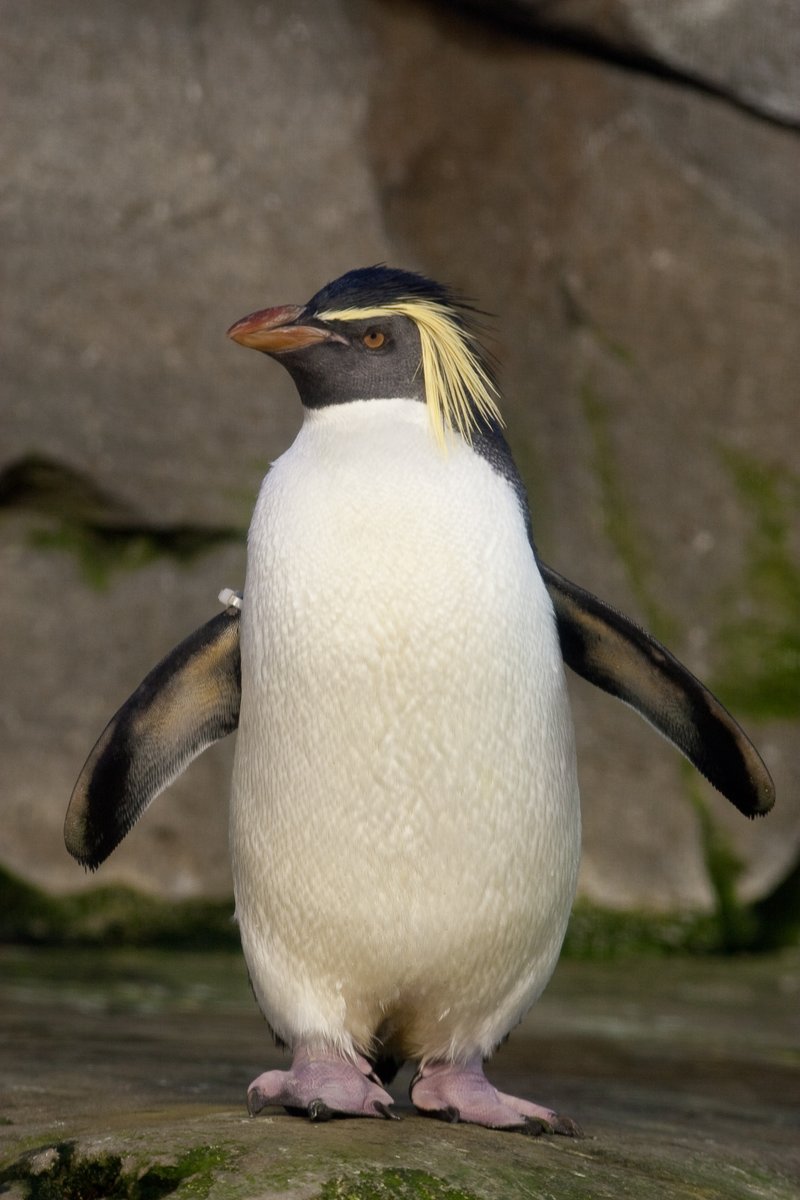
Photo: Brian Gratwicke via Wikimedia Commons (CC-BY 2.0)

Northern Rockhopper Penguin
Eudyptes moseleyi
EndangeredOverview
The northern rockhopper penguin is one of the most striking crested penguins, with a bold yellow crest that sweeps outward above blood-red eyes. Found on remote islands in the South Atlantic and Indian Oceans — Tristan da Cunha, Gough Island, and Amsterdam Island — it was long considered the same species as the southern rockhopper before genetic and vocalization studies confirmed it as distinct in 2006.
What sets the northern rockhopper apart from its southern cousin isn't just geography — it's the scale of decline. While southern rockhopper populations have also decreased, the northern species has crashed by roughly 90% since the 1950s. On Gough Island alone, the population fell from an estimated 2 million pairs to around 32,000–65,000 pairs in just a few decades. These numbers represent one of the most dramatic declines of any penguin species.
Like all rockhoppers, they're feisty birds that clamber over rocky shorelines rather than sliding on their bellies. They breed in dense colonies on steep, rugged terrain, returning to the same nest sites year after year. Their isolation on remote islands makes monitoring difficult, but it also means their populations are highly vulnerable to localized threats.
IUCN Status
The IUCN Red List classifies the northern rockhopper penguin as Endangered (2024 assessment). This reflects a population decline of over 80% over three generations, driven by habitat degradation, introduced predators, and shifting ocean conditions around their remote breeding islands.
The species was uplisted from Vulnerable as evidence accumulated showing that declines were more severe and widespread than previously understood. Climate-driven changes to sea surface temperature and marine productivity around Tristan da Cunha and Gough Island are reducing the availability of prey during critical breeding periods.
No MAPPPD Colony Data Available
Northern rockhopper penguins are not tracked by MAPPPD. Colony monitoring relies on direct surveys by researchers visiting these remote islands. Visit IUCN Red List for assessment details.
Conservation
The northern rockhopper penguin faces a convergence of threats that make recovery difficult. On Gough Island — a UNESCO World Heritage Site and one of their most important breeding grounds — introduced house mice prey on penguin chicks and eggs. The mice, which arrived with sealers and ships, have devastated ground-nesting seabird populations across the island.
Climate change is altering the marine ecosystem around their breeding islands. Shifts in sea surface temperature affect the distribution and abundance of krill and squid — the rockhopper's primary food sources. When prey moves further from breeding colonies, adults must make longer foraging trips, leaving chicks vulnerable and reducing breeding success.
Fisheries interactions add another layer of pressure. Trawling operations near breeding islands can cause direct mortality through bycatch and reduce prey availability through competition. Oil pollution from shipping routes poses a constant low-level risk. Conservation efforts focus on predator eradication programs (particularly mouse removal on Gough Island) and marine protected area designation around key breeding sites.
Sources
- IUCN Red List — Eudyptes moseleyi (Endangered, 2024 assessment)
- BirdLife International — global authority on bird conservation status
- Wikipedia — Northern rockhopper penguin
- Wikimedia Commons — Photo source