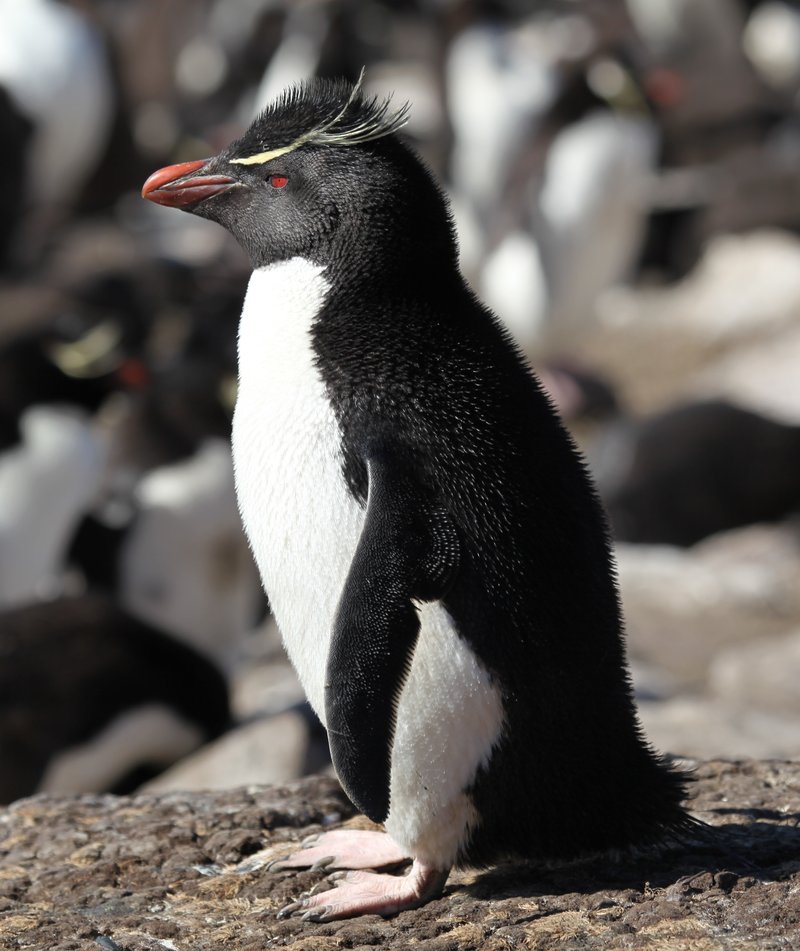
Photo: Rockhopper Penguin on Saunders Island — Wikimedia Commons, CC BY-SA 2.0
.jpg)
Southern Rockhopper Penguin
Eudyptes chrysocome
Red eyes, yellow crests, and they literally hop from rock to rock. Fiercer than they look.
Quick Facts
Overview
Southern rockhopper penguins are the punk rockers of the penguin world. With their spiky yellow and black crest feathers, blazing red eyes, and an attitude that more than compensates for their small stature, they're impossible to mistake for any other species. The name says it all: rather than waddle, these penguins hop from rock to rock on their steep, wave-battered breeding shores, using their powerful legs and sharp claws to navigate terrain that would stop most penguins dead.
Found across a broad arc of subantarctic territory — from the Falkland Islands through southern Chile and Argentina to islands in the Indian and South Atlantic Oceans — the southern rockhopper was once lumped together with its northern and eastern cousins as a single species. Genetic and vocalisation studies split them apart in the 2000s, and each has its own troubling population trajectory. The southern form, Eudyptes chrysocome, breeds primarily in the Falklands and along the southern tip of South America, with roughly a million pairs remaining.
But "a million pairs" obscures the reality. Population monitoring has revealed steep declines at many colonies, particularly in the Falklands, where numbers dropped by over 90% between the 1930s and early 2000s. The reasons are tangled together: warming ocean temperatures pushing krill and squid further from breeding sites, competition with commercial fisheries, and occasional oil spills that hit these dense colonies particularly hard. Rockhopper penguins are fierce individuals, but even fierce can't fight a warming ocean.
IUCN Status
Status: Vulnerable (assessed 2024)
Population trend: Decreasing
Key threats:
- Climate change warming ocean temperatures and shifting prey distribution
- Competition with commercial fisheries for krill and squid
- Oil pollution, particularly around shipping lanes near the Falklands
- Disturbance at breeding colonies from tourism and human activity
- Ocean acidification affecting krill populations
No MAPPPD Colony Data Available
The Mapping Application for Penguin Populations and Predicted Distributions (MAPPPD) does not currently track colony data for this species. While southern rockhopper penguins breed on subantarctic islands partially covered by MAPPPD, colony tracking for this species is not available in the database.
For population and conservation data, refer to:
IUCN Red List — Eudyptes chrysocome
BirdLife International — Southern Rockhopper Penguin
Conservation
The Falkland Islands hold the largest breeding population of southern rockhopper penguins, and conservation here has been a mixed story. Oil pollution from shipping has been a persistent problem — the 1986 and 1994 spills killed thousands of birds. The Falklands Conservation organisation monitors colonies annually, tracks population trends, and works to reduce fisheries bycatch. Marine Protected Areas around the islands provide some buffer for foraging grounds.
The deeper challenge is one that local conservation can't solve alone. Rockhopper penguins depend on krill and squid populations that are themselves shifting under climate change. As ocean temperatures rise, the cold-water prey these penguins rely on moves further south or deeper, forcing birds to swim longer distances and return with less food for their chicks. Without meaningful global action on climate change, local protections can only slow the decline — not reverse it.