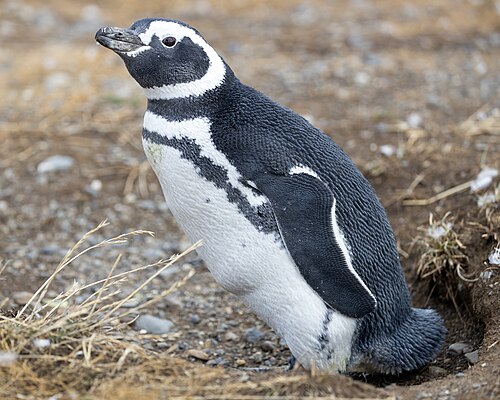
Photo: Magellanic Penguin (Spheniscus magellanicus) — Wikimedia Commons, CC BY 2.0
_(15953854011).jpg)
Magellanic Penguin
Spheniscus magellanicus
The most numerous of the banded penguins, named after the explorer Ferdinand Magellan who spotted them in 1520.
Quick Facts
Overview
The Magellanic penguin is the most numerous member of the Spheniscus genus — the banded penguins — with roughly 1.3 million breeding pairs spread along the coasts of Argentina, Chile, and the Falkland Islands. Named after Ferdinand Magellan, who recorded sighting them during his 1520 voyage through the strait that now bears his name, these penguins are medium-sized, robust, and recognisable by the two black bands that run across their white chest and the pink skin patches above their eyes.
They are birds of contrast — literally and figuratively. In the vast breeding colonies of Punta Tombo in Patagonia, hundreds of thousands gather each spring to dig burrows under scrubby vegetation, returning faithfully to the same nest and the same partner year after year. Some pairs have been documented staying together for over two decades. But the journey between breeding seasons is punishing: many migrate northward along the Brazilian coast during winter, swimming thousands of kilometres in search of food.
Oil pollution has been a devastating and persistent problem. Chronic oil dumping from shipping traffic along the Argentine coast killed an estimated 40,000 penguins per year during the 1980s and 1990s. Regulations have improved, but illegal bilge pumping continues. Meanwhile, overfishing of anchovies and sardines pushes the penguins further from their colonies in search of food, and climate change is shifting ocean temperatures and currents in ways that are reshaping the entire food web of the South Atlantic.
IUCN Status
Status: Near Threatened (assessed 2024)
Population trend: Decreasing
Key threats:
- Oil pollution from shipping — historically a major killer
- Overfishing of prey species (anchovies, sardines)
- Climate change shifting ocean temperatures and prey distribution
- Coastal development disturbing breeding sites
- Bycatch in commercial fishing operations
No MAPPPD Colony Data Available
The Mapping Application for Penguin Populations and Predicted Distributions (MAPPPD) does not currently track colony data for this species. Magellanic penguins inhabit temperate and subantarctic coastlines of South America outside the primary MAPPPD monitoring regions.
For population and conservation data, refer to:
IUCN Red List — Spheniscus magellanicus
BirdLife International — Magellanic Penguin
Conservation
While still numerous compared to many other penguin species, Magellanic penguin populations have declined significantly in some areas. The colony at Punta Tombo — once the largest at over 500,000 breeding pairs — has shrunk by more than 20% since the 1980s. The Punta Tombo Provincial Reserve provides some protection, but the penguins' foraging range extends well beyond its boundaries into heavily fished waters.
Oil pollution mitigation has been one of the biggest conservation success stories. After years of advocacy, Argentina enacted regulations requiring shipping lanes to be moved further offshore, reducing chronic oiling incidents dramatically. Rehabilitation centres like the Fundación Bioandina in Argentina continue to treat oiled and injured penguins, releasing hundreds back to the wild each year. But as ocean temperatures shift, the bigger challenge may be ensuring there's enough fish left within penguins' foraging range to sustain the next generation.