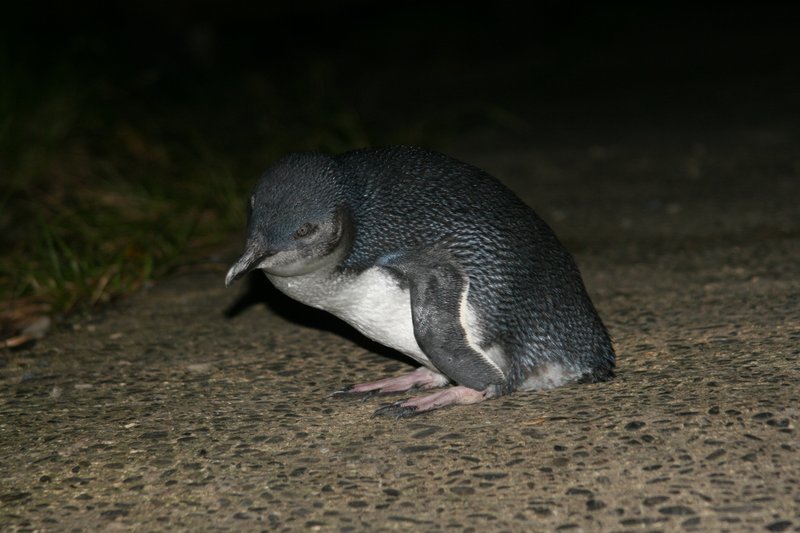
Photo: Blue Penguin Kapiti — Wikimedia Commons, CC BY-SA 3.0

Little Blue Penguin
Eudyptula minor
The smallest penguin species, barely 30cm tall. They come ashore at dusk in little groups called rafts. Adorable.
Quick Facts
Overview
The little blue penguin — also known as the fairy penguin or kororā in te reo Māori — is the smallest of all penguin species, standing just 30 centimetres tall and weighing barely a kilogram. Found along the coastlines of New Zealand and southern Australia, these diminutive seabirds are far more common than most people realise, though their nocturnal habits and modest size mean they're often overlooked.
Their slate-blue plumage is unique among penguins, providing camouflage against the dark ocean when viewed from above. They spend daylight hours foraging at sea, diving to depths of 20–60 metres in pursuit of small fish, squid, and crustaceans. At dusk, they return to shore in groups called "rafts" — a spectacle that has become a major tourist draw in places like Phillip Island, Australia, where penguin parades draw hundreds of thousands of visitors each year.
Nesting in burrows, rock crevices, or even under human-built structures, little blue penguins are remarkably adaptable — but this adaptability masks real declines in many areas. Introduced predators like cats, dogs, and stoats take a heavy toll, particularly on mainland New Zealand populations. Road traffic kills thousands annually in some areas, and habitat destruction along coastlines continues to squeeze available nesting sites.
IUCN Status
Status: Least Concern (assessed 2024)
Population trend: Decreasing
Key threats:
- Predation by introduced mammals (cats, dogs, stoats, ferrets)
- Habitat loss from coastal development
- Road mortality — significant in areas where roads run near colonies
- Bycatch in fishing nets
- Climate change affecting marine food supplies
No MAPPPD Colony Data Available
The Mapping Application for Penguin Populations and Predicted Distributions (MAPPPD) does not currently track colony data for this species. Little blue penguins inhabit temperate coastlines outside the Antarctic and subantarctic regions that MAPPPD focuses on.
For population and conservation data, refer to:
IUCN Red List — Eudyptula minor
BirdLife International — Little Penguin
Conservation
Despite their "Least Concern" status, little blue penguins face serious localised threats. Mainland populations in New Zealand have declined significantly due to introduced predators, while some Australian colonies remain stable thanks to active predator control and habitat protection.
Conservation efforts include predator-proof fencing around colonies, artificial nest box programmes, road signage and underpasses to reduce vehicle strikes, and community-based monitoring projects. The Oamaru Blue Penguin Colony in New Zealand is a model for how tourism and conservation can coexist — with careful management, the colony has grown from 33 breeding pairs in 1992 to over 200 today.