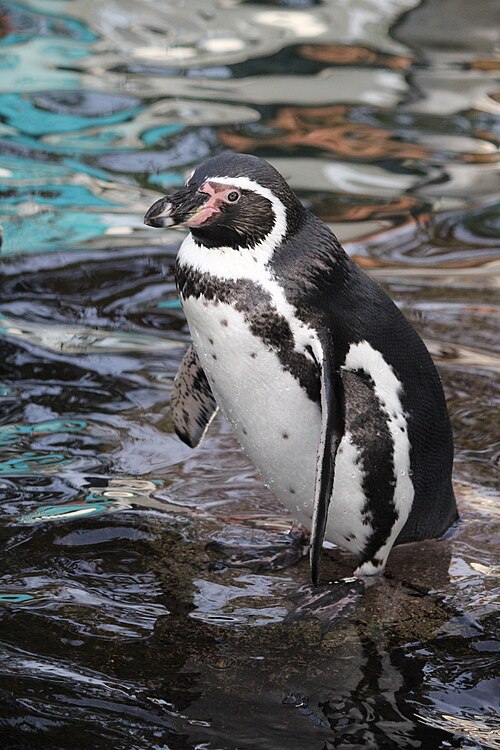
Photo: Spheniscus humboldti — Wikimedia Commons, CC BY-SA 2.0
.jpg)
Humboldt Penguin
Spheniscus humboldti
A desert-dwelling penguin. They nest in guano burrows, which humans keep harvesting for fertilizer. We're literally stealing their homes.
Quick Facts
Overview
The Humboldt penguin is a bird of contradictions. It lives in one of the driest deserts on Earth — the Atacama — yet depends entirely on the cold, nutrient-rich Humboldt Current that runs along the coast of Peru and Chile. Without that upwelling current bringing anchovies and sardines within diving range, these penguins simply cannot survive. And when El Niño shuts the current down, they starve.
Named after the explorer Alexander von Humboldt — the same Humboldt whose name adorns the current that sustains them — these penguins are medium-sized members of the banded penguin genus, distinguishable by their pink fleshy patch at the base of the bill and the single black band across their chest. They nest in deep burrows carved into centuries-old guano deposits, or in rocky crevices along the coast, returning to the same site year after year.
The guano that makes their homes possible is the same guano that humans have been mining for fertilizer since the 19th century. Historic guano harvesting stripped the deep deposits that penguins needed for safe, cool nesting, leaving them exposed on the surface where heat and predators take a heavy toll. Conservation programmes now install artificial nest burrows, but the underlying problems — overfishing, El Niño, and mining — continue to push this species toward a cliff edge it can't hop away from.
IUCN Status
Status: Vulnerable (assessed 2024)
Population trend: Decreasing
Key threats:
- Guano harvesting destroying nest sites — the burrows they depend on are being mined for fertilizer
- El Niño events causing dramatic food shortages and population crashes
- Overfishing of anchovies and sardines along the Humboldt Current
- Mining operations disturbing coastal habitats
- Introduced predators on nesting islands
No MAPPPD Colony Data Available
The Mapping Application for Penguin Populations and Predicted Distributions (MAPPPD) does not currently track colony data for this species. Humboldt penguins inhabit temperate coastlines of South America outside the Antarctic and subantarctic regions that MAPPPD focuses on.
For population and conservation data, refer to:
IUCN Red List — Spheniscus humboldti
BirdLife International — Humboldt Penguin
Conservation
Humboldt penguin conservation faces a fundamental tension: the very substance they need for nesting — guano — is commercially valuable as fertiliser. Peru and Chile have established reserves on some guano islands, restricting harvest during breeding season, but enforcement is patchy and the deep guano deposits that once existed are largely gone. Artificial nest boxes have been deployed with some success, mimicking the cool, dark burrows that natural guano provides.
The bigger, harder problem is El Niño. During strong events, the Humboldt Current weakens and warm water displaces the cold, anchovy-rich upwelling. In the devastating 1997–98 El Niño, Humboldt penguin populations crashed by up to 65% in some areas. Climate change is projected to increase the frequency and intensity of El Niño events, creating a cycle of recovery and collapse that the species may not be able to sustain. With only around 12,000 breeding pairs remaining, the margin for error is vanishingly thin.