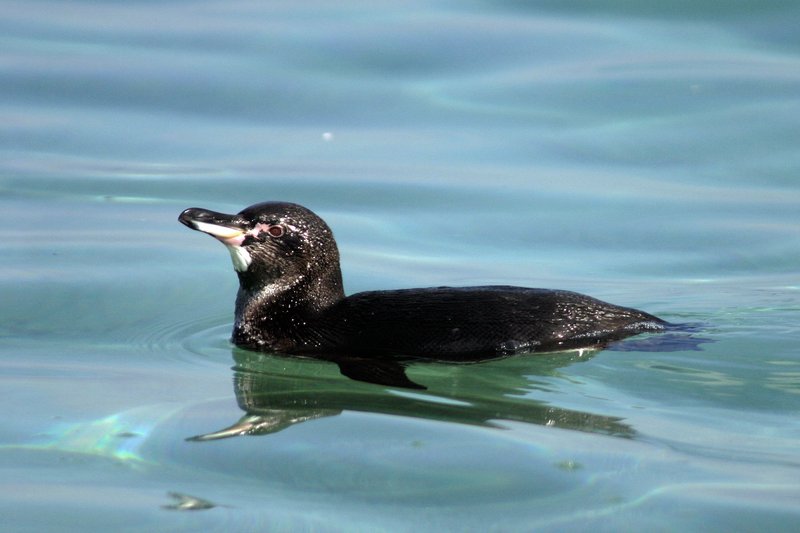
Photo: Galápagos penguin (Spheniscus mendiculus) male — Wikimedia Commons, CC BY-SA 3.0
_male.jpg)
Galápagos Penguin
Spheniscus mendiculus
Only about 1,200 individuals left. The only penguin that lives north of the equator, riding the cold current. One bad El Niño and they're in serious trouble.
Quick Facts
Overview
The Galápagos penguin is the rarest and most endangered of all penguin species — and the only one found north of the equator. Confined to the Galápagos archipelago, roughly 1,200 individuals cling to existence on the volcanic shores of Fernandina and Isabela Islands, surviving in the tropics only because the cold Cromwell Current sweeps nutrient-rich water up from the deep ocean along the western coast of the islands.
They are the second-smallest penguin species, barely half a metre tall, and their entire existence depends on a single oceanographic phenomenon. When the Cromwell Current weakens during El Niño events, the food chain it supports collapses. During the 1982–83 El Niño, the Galápagos penguin population crashed by an estimated 77%. The 1997–98 event killed another 65%. These penguins live in a perpetual cycle of slow recovery punctuated by catastrophic die-offs.
Nesting in lava tubes and rocky crevices — there are no burrows to dig in solid basalt — Galápagos penguins breed opportunistically, whenever conditions allow. Both parents incubate the eggs and care for chicks, but in lean years they may skip breeding entirely or abandon nests. Introduced predators — rats, cats, and dogs brought by human settlements — have added predation pressure to what is already one of the most precarious existences in the animal kingdom.
IUCN Status
Status: Endangered (assessed 2024)
Population trend: Decreasing
Key threats:
- El Niño events — can reduce population by 70% or more in a single event
- Climate change increasing El Niño frequency and intensity
- Introduced predators (rats, cats, dogs) on nesting islands
- Extreme small population size — vulnerable to stochastic events
- Fishing operations in foraging areas
No MAPPPD Colony Data Available
The Mapping Application for Penguin Populations and Predicted Distributions (MAPPPD) does not currently track colony data for this species. Galápagos penguins inhabit tropical equatorial islands outside the Antarctic and subantarctic regions that MAPPPD focuses on.
For population and conservation data, refer to:
IUCN Red List — Spheniscus mendiculus
BirdLife International — Galápagos Penguin
Conservation
Conservation work on the Galápagos penguin is inseparable from the broader management of the Galápagos Islands — a UNESCO World Heritage Site. The Charles Darwin Foundation and the Galápagos National Park Directorate have led efforts to control introduced predators on key breeding islands, particularly Isabela and Fernandina. Hand-rearing of abandoned chicks during El Niño years has also shown promise, though the scale is necessarily small.
The greatest long-term threat is beyond local control: climate change is projected to increase the frequency and severity of El Niño events. Each strong event pushes this tiny population closer to the edge. With only about 1,200 individuals, a single particularly bad year could bring the species to functional extinction. The Galápagos penguin is a stark reminder that even in one of the most protected places on Earth, species can't be insulated from global forces.