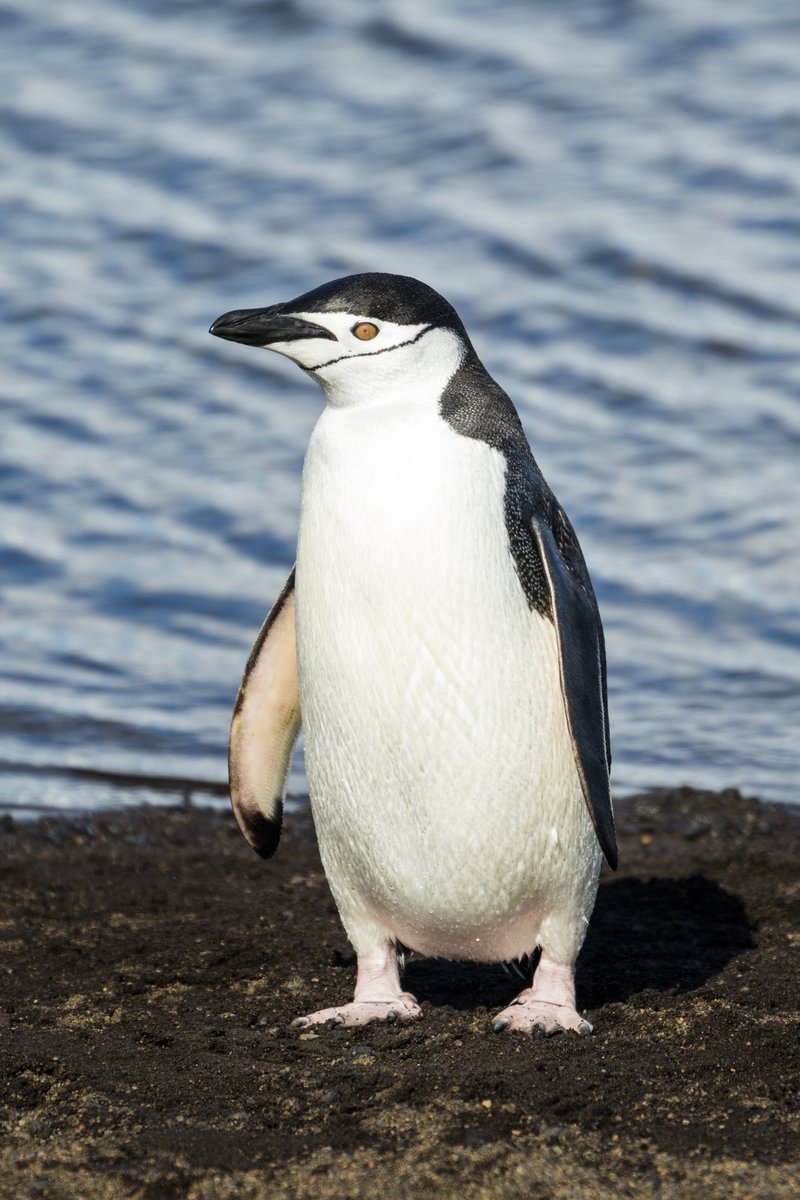
Photo: Andrew Shiva via Wikimedia Commons (CC-BY-SA 4.0)
_04.jpg)
Chinstrap Penguin
Pygoscelis antarcticus
VulnerableOverview
The chinstrap penguin gets its name from the narrow black band under its chin that makes it look like it's wearing a helmet — one of the most distinctive and easily recognized markings in the penguin family. Also known as the ringed penguin, bearded penguin, or stonecracker penguin (for its notoriously loud call), this species breeds on the Antarctic Peninsula and subantarctic islands in massive, noisy colonies.
Chinstrap penguins are among the most social of all penguin species, forming dense breeding colonies that can number in the hundreds of thousands on islands like Zavodovski in the South Sandwich group. Their loud, harsh calls create an overwhelming wall of sound at colony sites — hence "stonecracker." They build nests from pebbles on ice-free ground and are known for their aggressive territory defense.
Their near-total dependence on krill makes them especially vulnerable to changes in the Antarctic marine ecosystem. As sea ice declines and krill populations shift, chinstraps are often the first to show the impact — a canary in the Southern Ocean coal mine.
IUCN Status
The chinstrap penguin was uplisted to Vulnerable on the IUCN Red List (2025 assessment), reflecting significant population declines observed across much of its range. While still numerous in absolute terms — with roughly 8 million individuals — the species has experienced population reductions of 30% or more at many monitored colonies over the past three generations.
The primary driver is declining krill abundance in the Antarctic Peninsula region, where warming waters have reduced sea ice extent and disrupted the base of the food web. Colonies that were once among the largest in Antarctica have shown steep declines, particularly in the South Shetland and South Orkney islands.
Colony Data Available
Colony data sourced from MAPPPD (Mapping Application for Penguin Populations and Projected Dynamics). Visit penguinmap.com for full interactive data.
Conservation
Chinstrap penguins' reliance on krill puts them at the center of a growing ecological crisis in the Southern Ocean. Krill populations have declined by an estimated 80% since the 1970s in the Antarctic Peninsula region, driven by reduced sea ice and increasing commercial fishing pressure. As krill-dependent specialists, chinstraps have fewer dietary alternatives than their more adaptable cousins, the gentoos.
This dietary specialization has created a stark population dynamic: where gentoos are expanding southward as ice retreats, chinstraps are declining across their range. Surveys at Elephant Island in 2020 showed chinstrap populations had dropped by over 50% compared to surveys from the 1970s, while gentoo populations in the same area had increased.
Climate change compounds the krill problem by altering the timing of sea ice formation and breakup, which affects when and where krill are available during the critical breeding season. Protecting marine foraging areas and limiting krill fishing near breeding colonies are the most immediate conservation priorities.
Sources
- IUCN Red List — Pygoscelis antarcticus (Vulnerable, 2025 assessment)
- BirdLife International — global authority on bird conservation status
- Wikipedia — Chinstrap penguin
- Wikimedia Commons — Photo source
- MAPPPD — Penguin colony tracking data