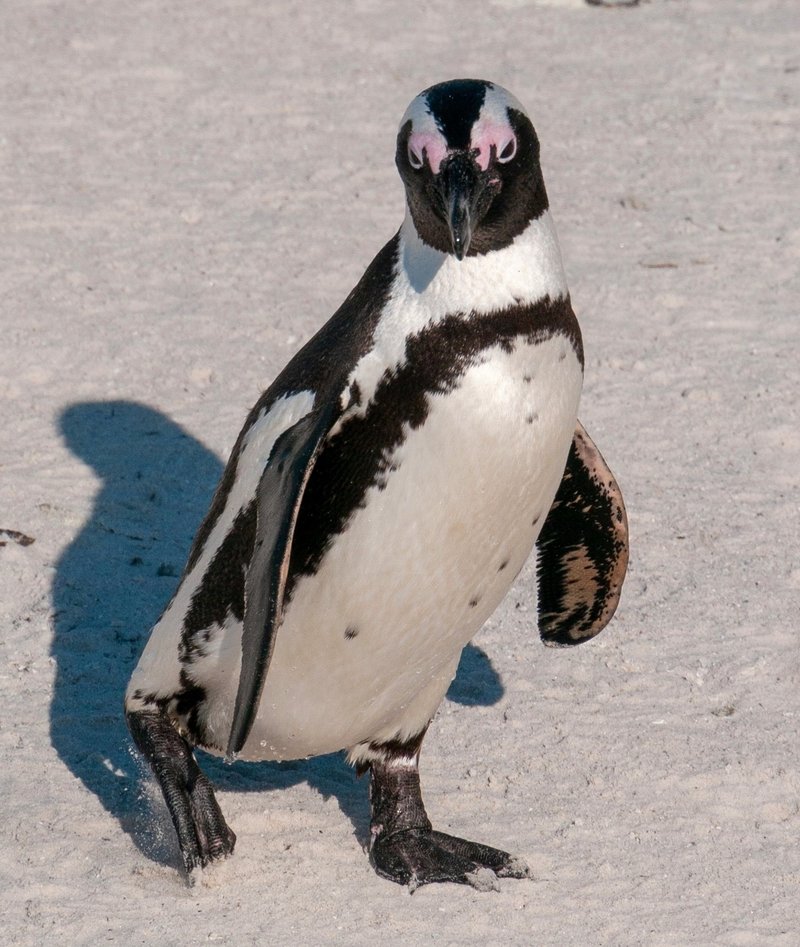
Photo: African Penguin at Boulders Beach — Wikimedia Commons, CC BY-SA 4.0
African Penguin
Spheniscus demersus
Population crashed from millions to about 20,000 pairs. This is what extinction looks like in slow motion.
Quick Facts
Overview
The African penguin — also called the Cape penguin or jackass penguin for its donkey-like bray — is the only penguin species found on the African continent. Once numbering in the millions along the coasts of South Africa and Namibia, their population has crashed by over 95% in the last century. Today, roughly 20,000 breeding pairs remain, scattered across dwindling colonies on the mainland and offshore islands.
Distinguished by their black facial mask and unique pink patches of bare skin above the eyes — which help them thermoregulate in the African heat — these penguins are pursuit divers, hunting sardines and anchovies in the cold Benguela Current. But the same current that sustains them has been disrupted by decades of overfishing and climate change, pushing fish stocks away from traditional breeding grounds. When the fish move, the penguins must swim further, burning more energy and returning less food to their chicks.
Historically, African penguins nested in deep layers of guano that provided cool, sheltered burrows. Commercial guano harvesting in the 19th and 20th centuries stripped these deposits bare, forcing penguins to nest on open ground where eggs and chicks are exposed to predators and the blazing sun. Oil spills from shipping traffic off the Cape have caused recurring mass mortality events — the MV Treasure spill in 2000 oiled over 20,000 penguins in a single incident.
IUCN Status
Status: Endangered (assessed 2024)
Population trend: Decreasing — rapid decline continues
Key threats:
- Overfishing of sardines and anchovies reducing food supply
- Climate-driven shifts in fish stocks away from breeding colonies
- Oil spills from shipping traffic off the Cape
- Guano harvesting destroying nest sites
- Predation by seals and kelp gulls
No MAPPPD Colony Data Available
The Mapping Application for Penguin Populations and Predicted Distributions (MAPPPD) does not currently track colony data for this species. African penguins inhabit temperate coastlines outside the Antarctic and subantarctic regions that MAPPPD focuses on.
For population and conservation data, refer to:
IUCN Red List — Spheniscus demersus
BirdLife International — African Penguin
Conservation
The African penguin is in serious trouble, and conservation efforts are racing against time. The South African government has established no-fishing zones around key breeding colonies — an attempt to ensure penguins have enough prey within foraging range. Artificial nest boxes are being deployed to replace the lost guano burrows, providing shade and protection for eggs and chicks.
The Southern African Foundation for the Conservation of Coastal Birds (SANCCOB) has been at the forefront of rehabilitation efforts, rescuing and treating oiled and injured penguins since 1968. The organisation has treated over 95,000 seabirds, with African penguins making up the majority of admissions. At Boulders Beach near Cape Town, a thriving colony has become one of the few success stories — though even here, numbers have declined from over 3,000 breeding pairs in 2005 to under 1,000 today.